The mobile example apps
The Example Shop as two apps, in the package examples/react-native (Expo) and examples/capacitor, with the Express example as their server: sign in as Ben in the app and as Ann in a browser, and they see each other.
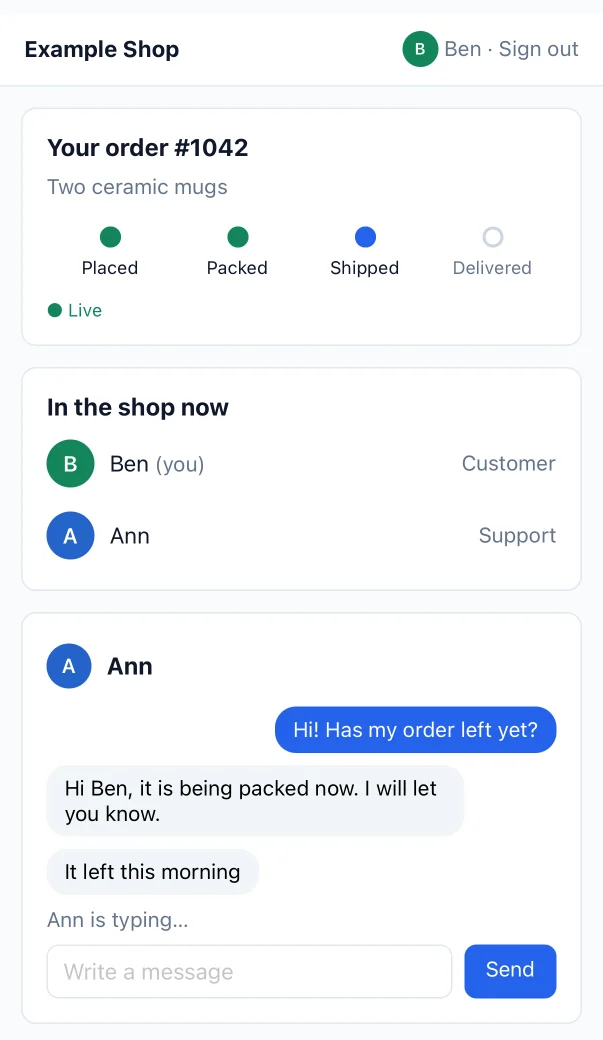
| React Native | Capacitor | |
|---|---|---|
| The order of Ben, as Ann moves it on | join() on the order:{id} room | the shop page, shop/shop.js |
| Who is in the shop | the shop presence room | <wordplus-online>, with a call button for each |
| The chat | messages emitted with an ack and kept, typing as volatile events | <wordplus-chat>, with reactions and read ticks |
| Calls and the daily meeting | later (they need a WebRTC module) | the call screen, as in a browser |
| The order timeline, the mugs and who is looking, the webhooks | the shop page, as in a browser |
Try it online at mobile.docs.wordplus.cloud: the Capacitor app in a phone, signed in as Ben, beside the page of Ann in the same shop, a shop of your own for a day, whose calls end after 10 minutes and meetings after 15. Swift and Kotlin apps have guides of their own: iOS and Android.
The server
cd examples/express
cp .env.example .env       # the key and secret of your app, and a local key
npm install && npm start   # http://localhost:3000, with POST /api/token for the apps
It signs an app in with POST /api/token, answers its requests by the token (Authorization: Bearer …), and answers the Capacitor address with CORS. Add capacitor://localhost and https://localhost to your app in WordPlus Cloud for Capacitor.
React Native
cd examples/react-native
npm install
EXPO_PUBLIC_SHOP_SERVER=http://localhost:3000 npx expo start     # i: the iOS simulator, a: the Android emulator (10.0.2.2:3000)
Sign in as one of the shop people, or open the app with a link that signs in: exp://<your Mac>:8081/--/?as=42 in Expo Go.
| File | |
|---|---|
index.ts | react-native-get-random-values, first |
shop.ts | signing in with the server token, and connect() from @wordplus/realtime/native with its settings |
App.tsx | the screens: the order, who is in the shop, and the chat |
Capacitor
cd examples/capacitor
npm install
SHOP_SERVER=https://shop.example.com npm run build    # the shop page into www/, with the worker, the room client and the components
npx cap add ios && npm run ios                         # or android
| File | |
|---|---|
src/app.js | signing in with the server token (or, in the demo phone, the token its address brings), then the shop page with the server routes in full |
shop/ | the shop page, the same as in every example |
capacitor.config.json | the app, its web folder, the Android https scheme |
The Capacitor app is among the examples @wordplus/realtime checks on every change, with Ben in the app and Ann and Cara in browsers.