Presence in mobile apps
A presence room lists who is in it to everyone in it, and says when someone arrives and leaves. A count says how many are in a room, at any size. And who is online is known across your whole app. An app and the web pages are in the same rooms: a customer in the app sees the agents online in their browsers, and they see the customer.
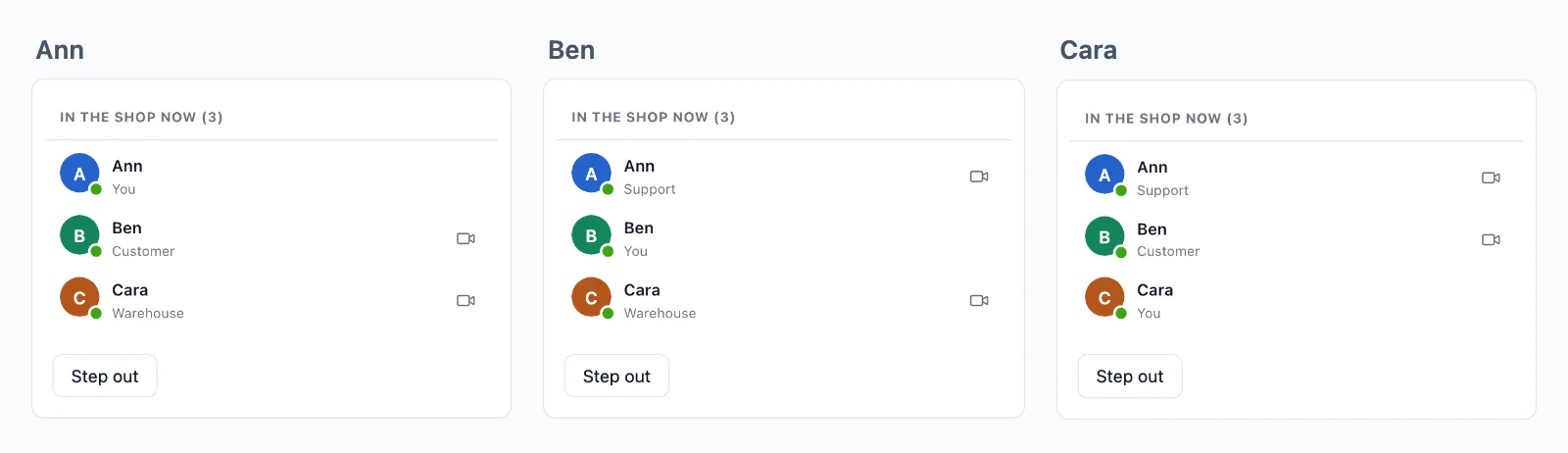
Your server says who may join and what the others see of them, as for your pages. One room for the whole shop, named shop: the app asks your server to join it, and the rule your server declared for it answers, here letting in the signed-in users, each with their name and role (a presence room).
React Native
import { Text } from 'react-native';

function InTheShop( { rt, me }: { rt: Realtime; me: number } ) {
    const [ members, setMembers ] = useState<Array<[ string, unknown ]>>( [] );

    useEffect( () => {
        const shop = rt.join( 'shop' );
        const draw = () => setMembers( [ ...shop.members ] );   // [ [ id, info ], … ]
        for ( const event of [ 'joined', 'join', 'leave' ] ) shop.on( event, draw );
        return () => rt.leave( 'shop' );
    }, [ rt ] );

    return members.map( ( [ id, info ] ) => <Text key={ id }>{ ( info as { name: string } ).name }{ id === String( me ) && ' (you)' }</Text> );
}
Under a RealtimeProvider, usePresence( 'shop' ) gives the same members, kept current (the React reference).
Capacitor
const shop = rt.join( 'shop' );
shop.on( 'joined', () => draw( [ ...shop.members ] ) );
shop.on( 'join', ( { id, info } ) => add( id, info ) );
shop.on( 'leave', ( { id } ) => remove( id ) );
Or the Better Messages list, with a call button for each of the others, as in a browser, once await rt.callScreen() has loaded the elements (rt.ui() loads them without calls):
<online-list room="shop" title="In the shop now" token-url="https://shop.example.com/api/call-token" type="video"></online-list>
Each of the others has a call button, which asks your route as it is pressed, as on a page, and someone your route refuses is told so (ready-made). token-url is written in full, as in calls.
Counting
A room your server declares with count: true gives the app a live count, without a list: here product:7, the page of product 7, a public room anyone may join. The same in React Native and Capacitor:
const product = rt.join( 'product:7' );
product.on( 'count', ( n ) => showLooking( n ) );   // at most once a second. product.count holds the latest
In Capacitor, <online-count room="product:7"></online-count> draws it.
Who is online
rt.online.watch( [ 34, 43 ] ).on( 'change', ( { id, online, at } ) => dot( id, online ) );   // their status now, then every change
rt.online.has( 34 );                                   // for a user watched
rt.online.lastSeen( 43 );                              // when, in ms, for one offline
rt.online.on( 'count', ( n ) => showOnline( n ) );     // how many are online, live
- In React Native, under a
RealtimeProvider,useOnline( [ 34, 43 ], { count: true } )gives the same, kept current. - One member, online once: a user with the app and a browser open leaves when their last connection does.
- In the background, an app the platform pauses drops its connection after a while: its user leaves the room, and goes offline 10 seconds later. They come back with it.
- Hiding: a user who chose not to show their status is never online to anyone, as your server
hiddensays (who is online). - Up to 1,000 members are listed in full. A room counts the rest, up to 100,000.
Use cases
Each with the rules of your server and the code of the page, which a Capacitor app runs as it is:
- Who is online and who is here: a dot on every avatar, the people in a room, and a live count
- Editing together: who is in a document, their cursors and their changes
More, with the code of every server: presence in depth.